
HAIRTWO Journal ·
Scalp roller 0.5 mm: how to use a derma roller safely
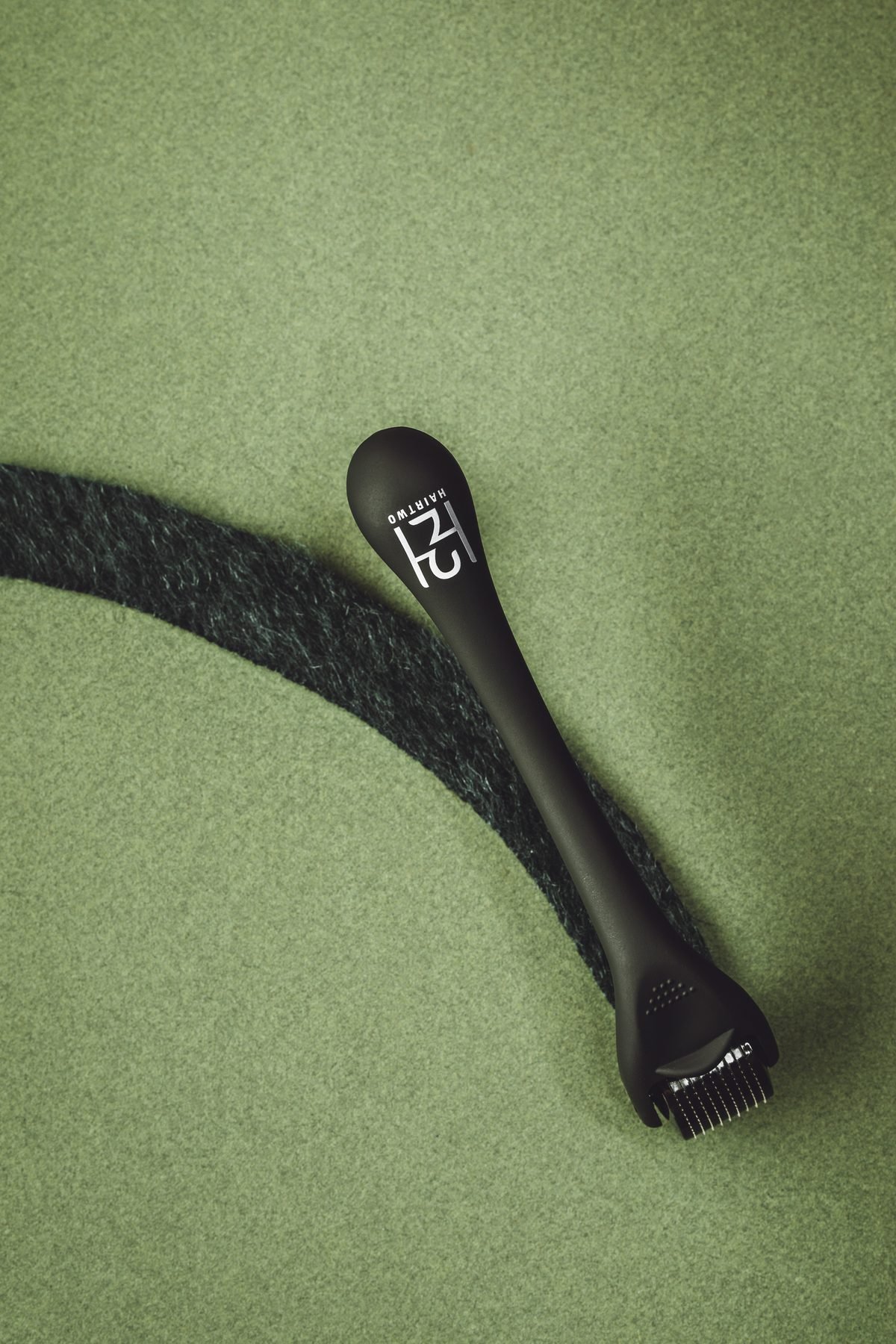
A scalp roller is a small tool, but it is still 540 real needles pressed into your skin. So this guide is about doing it safely rather than about results: what “0.5 mm” actually means, how to keep the roller clean, how often and how hard to roll, who should leave it in the drawer, and when to stop and see your GP. We use the roller from our HAIRTWO hair routine kit as the example, but most of this applies to any derma roller you use on your scalp.
To be clear from the start: we don’t claim that rolling makes hair grow. The roller is a personal-care accessory, not a treatment.
What does 0.5 mm mean?
It’s the length of each needle. Our roller has 540 titanium micro-needles, each 0.5 mm long, on a plastic handle. DermNet, the dermatology reference site, notes that professional skin-needling devices go up to 3 mm, with about 0.5 mm typically used, while the home models it describes have shorter, 0.2 mm needles.
The American Academy of Dermatology (AAD) says products sold for at-home microneedling aren’t meant to puncture the skin, but that sometimes they do, which could lead to infection or scarring. That’s why a 0.5 mm roller deserves a gentle hand and a strict cleaning habit.
Hygiene comes first
Two rules matter more than anything else. The roller is for your use only: never share it, not even with your partner or daughter, because infections can be passed on. And you clean and disinfect it before and after every use, as described in the instructions.
Why so strict? The AAD warns that at-home microneedling can accidentally spread warts, herpes and other viruses across the skin. In its guidance for dermatologists, it lists non-sterile devices, reused needles and contaminated serum bottles among the risk factors for infection. So wash your hands too, let the roller air-dry after disinfecting it, and keep it in its case.
How to use a scalp roller, step by step
Pick one evening a week
Our instructions are once a week, on an evening when you don’t apply the serum. You’ll find blogs suggesting every few days or even daily use of a 0.5 mm roller. We stick to weekly on purpose: the AAD notes that overdoing microneedling can irritate the skin.
Start with a clean, dry scalp
Wash and condition as usual, then let your scalp dry completely. Don’t roll on wet hair, or over oils, dry shampoo or styling products. Disinfect the roller as the instructions describe and check the needles look straight and undamaged.
Roll lightly, in a few directions
Part your hair, lay the roller flat on the scalp and roll gently back and forth a few times: front to back, side to side and diagonally. Then move to the next section. The AAD warns that pressing too hard can damage the skin and may lead to scarring or changes in colour or texture. If it hurts, ease off or stop.
No serum just before or during rolling
Never apply serum just before or during rolling, and skip the serum altogether that evening. Our 3D Bio-Boost Serum is made for intact skin and contains fragrance. In JAMA Dermatology, doctors described three women who developed granulomas (firm lumps) on the face after microneedling; two had a positive patch test to a serum applied beforehand. The authors warn that products applied before microneedling can carry particles deeper into the skin. The AAD likewise notes that complications may be amplified when biologically active serums are applied during or straight after needling.
Clean it again and put it away
Clean and disinfect the roller, let it dry and store it in its case. The next day, carry on with your normal routine.
Who shouldn’t use it
This is the safety list from our product page, word for word:
- For personal use only. Never share the roller, because infections can be passed on.
- Clean and disinfect the roller before and after every use, as described in the instructions.
- Don’t use it on a damaged, irritated, inflamed or infected scalp, or on open wounds, eczema, psoriasis, acne or scar tissue.
- Don’t use it if you know you’re allergic to titanium or nickel.
- If you take blood thinners, have a clotting disorder, diabetes or a weakened immune system, talk to your doctor first.
- Not suitable for children. Keep out of their reach.
- Replace the roller as the instructions say, because the needles get blunt.
- Stop and see a doctor if redness, pain, swelling or signs of infection don’t go away.
For microneedling in general, the AAD adds: skin that heals slowly or poorly, a keloid scar, skin cancer treatment in that area, radiation treatment, and less than a month since your last isotretinoin tablet. It also advises waiting if you have a recent tan or sunburn, a skin infection or painful spots.
When to replace it
Replace the roller as the instructions say, because the needles get blunt. The AAD lists dull needles, excessive depth and dragging among the things that may increase the risk of scarring. If you notice bent, blunt or damaged needles, stop using it. DermNet also points out that poor-quality instruments can lead to needles breaking off in the skin.
What the evidence says about the risks
Most of what we know comes from clinic treatments, not home rolling, but it shows what can go wrong.
- Usually short-lived. A systematic review of 85 articles (Chu and colleagues, Dermatologic Surgery, 2021) found the most common side effects were expected, temporary reactions lasting up to about seven days, such as redness, swelling, pain and dry or flaking skin.
- Occasionally lasting. Less common but more serious were dark marks after inflammation, “tram-track” scarring and granulomatous reactions. Active infection, darker skin and metal allergies raised the risk, and the authors urge caution with products not approved for use within the skin.
- Infection. DermNet describes bacterial skin infection and cold-sore flare-ups as rare, and mentions granulomatous reactions possibly linked to products pushed into the skin or to nickel allergy.
- Without medical training. According to the AAD, the risk of infection, scarring or long-lasting discolouration goes up when microneedling is done by someone without medical training.
At home, nobody is checking your technique. That’s exactly why light pressure, once a week and strict hygiene matter so much.
When to see your GP or a dermatologist
- Stop rolling and see a doctor if redness, pain, swelling or signs of infection don’t go away.
- If your hair is coming out suddenly, in patches or in large amounts, or you have other symptoms, see your GP or a dermatologist first.
- The NHS says to see a GP if you’re worried about your hair loss, and to tell them if it’s affecting your wellbeing.
Some shedding is normal: the NHS notes we can lose between 50 and 100 hairs a day, often without noticing.
The HAIRTWO routine is cosmetic scalp and hair care, not a medical treatment. Results vary, and some people see no change. You’ll find the full how-to and safety information on the HAIRTWO hair routine kit page.
Sources
- HAIRTWO, Hair routine kit: how to use and scalp roller safety information: https://tryhairtwo.com/hair-routine-kit/
- American Academy of Dermatology (AAD), Microneedling (patient information): https://www.aad.org/public/cosmetic/scars-stretch-marks/microneedling-fade-scars
- American Academy of Dermatology (AAD), Microneedling (guidance for dermatologists): https://www.aad.org/member/clinical-quality/clinical-care/emerging-diseases/viral-trends/microneedling
- DermNet, Skin needling: https://dermnetnz.org/topics/skin-needling
- Chu S, Foulad DP, Atanaskova Mesinkovska N. Safety Profile for Microneedling: A Systematic Review. Dermatol Surg. 2021;47(9):1249-1254: https://pubmed.ncbi.nlm.nih.gov/34448760/
- Soltani-Arabshahi R et al. Facial Allergic Granulomatous Reaction and Systemic Hypersensitivity Associated With Microneedle Therapy for Skin Rejuvenation. JAMA Dermatol. 2014;150(1):68-72: https://pubmed.ncbi.nlm.nih.gov/24258303/
- NHS, Hair loss: https://www.nhs.uk/conditions/hair-loss/
Written by the HAIRTWO team with the help of AI tools and checked against the sources above. General information, not medical advice.